

English translation provided for reference. Original images are retained in their source language.
Global technological competition is intensifying, how to makeTransformation of scientific and technological innovation achievementsIt is a practical need and an important issue to be solved in the high-quality development stage of China's economy. "Application scenarios" are the key link between technological innovation and industrial development.
In recent years, from embodied intelligence tolow altitude economy, the development of a number of emerging industries is confirming this logic. Humanoid robots and low-altitude aerial vehicles, these technological products have high R&D costs. Without sufficient rigid application scenarios, it will be difficult to form sustainable market demand.
China’s emphasis on application scenarios continues to increase: This year’s government work report proposed that large-scale application demonstration actions for new technologies, new products, and new scenarios should be carried out. The "15th Five-Year Plan" recommendations adopted by the Fourth Plenary Session of the 20th Central Committee of the Communist Party of China proposed to cultivate and apply new technologies, new products, and new scenarios, and increase the construction and opening up of application scenarios.
Last Friday, the State Council held another executive meeting to deploy and accelerate scenario cultivation and opening up to promote large-scale application of new scenarios.
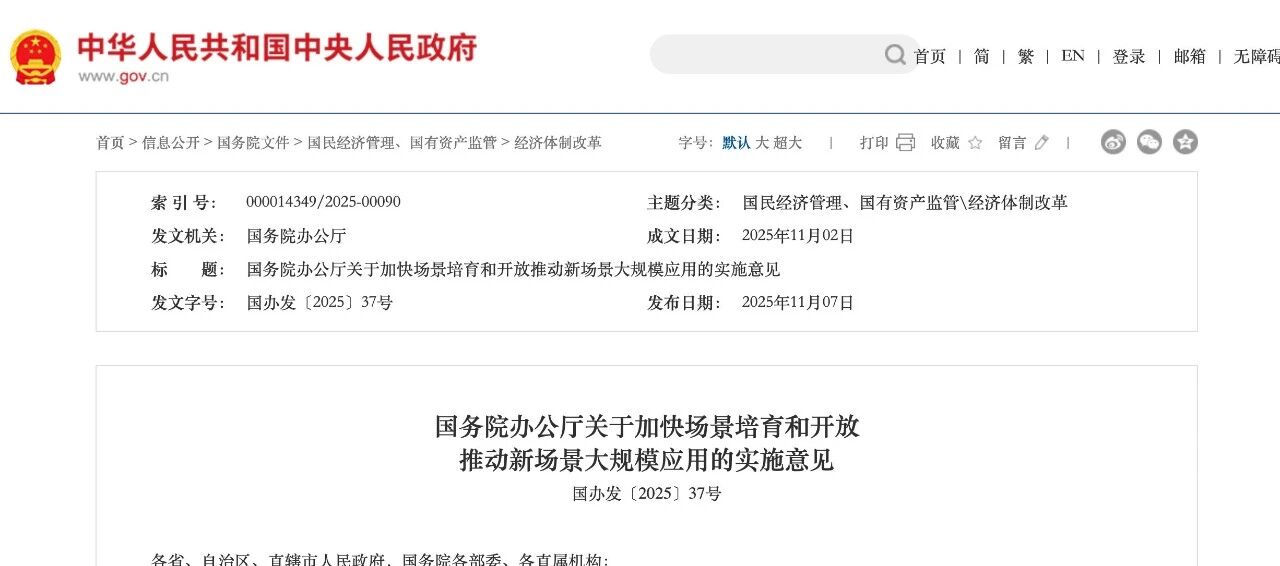
The meeting emphasized the need to give full play to the advantages of China's ultra-large-scale market and rich application scenarios, focus on the connection between supply and demand, face the forefront of industrial development and major technological research needs, prioritize the deployment of a number of new fields and new track scenarios, high-value small-cut scenarios and cross-regional and cross-domain comprehensive scenarios, and do a good job in opening scenario resources, pilot verification innovation, and business model exploration to promote the formation of a complete closed loop from technological breakthroughs to industrial applications.
The meeting also required that reform and innovation methods be used to cultivate more new scenarios, promote the construction of hardware such as infrastructure and platforms, provide software support such as regulations, systems, and policies, strengthen departmental coordination, improve regulatory mechanisms, and create a good innovation ecosystem.
What is the key to promoting the implementation of application scenarios?Southwest University Changshu Research Institute Compiled the interpretations of many experts.
1. Practical drills on large-scale use of new technologies
Zhu Keli: Economist, Founding President of Guoyan New Economic Research Institute
Application scenarios are practical training grounds for new technologies and new products to achieve scale and commercialization.
Taking new energy vehicles as an example, without charging scenarios composed of infrastructure such as charging piles, as well as diverse travel scenarios such as urban commuting and long-distance travel, issues such as battery life and charging convenience cannot be discovered and optimized in the real environment. Only when new energy vehicles are continuously tested and improved in various actual scenarios can the products be recognized by the market.
China has a huge and diverse market, and the differentiated needs of different regions, industries and groups provide a wealth of implementation scenarios for new technologies.
Which technologies and scenarios deserve attention? In the low-altitude economy, electric vertical take-off and landing aircraft have huge potential, which can open up air traffic scenarios when urban traffic is congested and achieve rapid point-to-point transportation. Emergency rescue scenarios can also be developed for emergency rescue in disasters such as earthquakes and floods.

In the launch economy, augmented reality technology (AR) has broad development space and can be used in cultural tourism scenarios, allowing tourists to wear AR devices to recreate the original appearance of historical sites and understand historical stories; it can also be used in education and training scenarios, allowing students to use AR to intuitively learn complex knowledge such as biological anatomy and mechanical structures.
To cultivate scenarios, we need to be open and inclusive, break down departmental and industry barriers, and encourage participation from multiple parties. The government should simplify approvals, introduce supporting policies, and improve infrastructure, including digital and physical infrastructure, such as intelligent connected vehicle test roads and Internet of Things communication networks.
At the same time, it is crucial to establish a scenario supply and demand docking mechanism. Online and offline platforms can be used to accurately match the supply and demand of new technologies and new products, and scenario design can be continuously optimized through scenario experience feedback.
2. Drive technology implementation from market demand
Zhong Huiyong: Associate researcher, doctoral supervisor, Antai School of Economics and Management, Shanghai Jiao Tong University, China Development Research Institute
In the future, we must strengthen the cultivation and opening of application scenarios and promote the implementation of new technologies based on real market demand.
China's advantages lie in its ultra-large-scale market and rich application scenarios. It is necessary to promote the precise matching of technology supply and market demand to form a virtuous cycle of technological breakthroughs, scenario testing, industrial applications, generating benefits, and driving more technological breakthroughs.
Among them, new fields and new track scenarios may include comprehensively promoting the implementation of autonomous driving as soon as possible.
High-value small incision scenarios mean precise empowerment, not seeking to be big and comprehensive, but to find clear pain points and solve them with new technologies.
Comprehensive cross-regional and cross-field scenarios mean that future open application scenarios will be systematic projects, not small-scale openings, but driven by the central government to break down departmental barriers and significantly promote comprehensive and overall reform measures.
3. "AI+" empowers industries
Hu Guodong: Deputy Secretary of the Party Committee of the China Electronic Information Industry Development Research Institute (referred to as "Saidi Research Institute") of the Ministry of Industry and Information Technology, Director of the Key Laboratory of Artificial Intelligence Scenario Application and Intelligent System Evaluation, Ministry of Industry and Information Technology
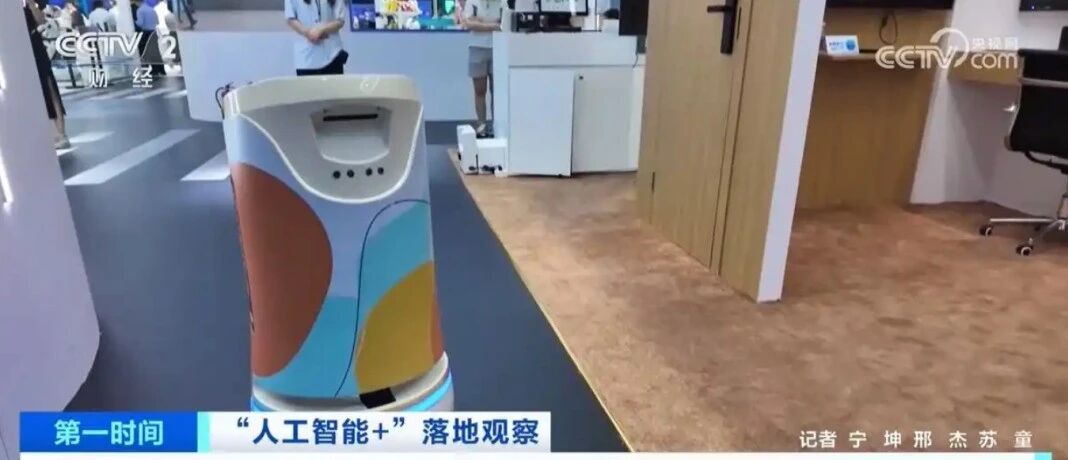
The key to promoting the large-scale application of new technologies, new products, and new scenarios is to expand the typical application scenarios of "AI+".
Taking the humanoid robot industry as an example, it faces two major challenges: low product maturity, high production and maintenance costs, and is still far from industrialization; high-value application scenarios are limited, and commercialization is difficult.
In order to expand application scenarios, the Ministry of Industry and Information Technology has clarified three types of directions for humanoid robots: special fields (harsh or dangerous scene operations), typical manufacturing scenes (3C, automobiles, etc.), people's livelihood and key industries (medical, housekeeping, etc.).
Technological innovation and industrial development should be closely linked to application scenarios that solve demand pain points and give full play to the traction effect of scenario applications.
Technological breakthroughs need to be applied on a large scale in implementation scenarios, and the implementation of scenarios depends on the innovation ecosystem. High-value scenarios such as intelligent production scheduling, human-machine collaboration, and predictive maintenance should be opened up in industries such as electronics, automobiles, machinery, and medicine to promote the large-scale application of AI in key industries.
At the same time, cultivate digital management of manufacturing enterprises,Smart manufacturing, networked collaboration, personalized customization, service-oriented extension, platform-based design and other new models and new business formats to promote the development of all elements of the industry driven by AI.
4. Hardware and software support two-wheel drive
Zhong Shihu: Deputy Director and Associate Professor of Modern Industry Development Research Center of Shanghai National Accounting Institute
The National Standing Committee proposed to "accelerate the cultivation and opening up of scenarios and promote the large-scale application of new scenarios", which captured the core pain point of China's current economic development - how to transform technological potential and market scale advantages into actual industrial competitiveness.
Hardware is the foundation, including new digital infrastructure, computing power platforms, pilot verification platforms, data open platforms, etc. that support new scenarios. Without these, self-driving cars will have no way to test, and artificial intelligence algorithms will have no data to train.
Software support is also critical. Many new technologies are popular but not popular because the system has not kept up with technological development.
At present, regulations are relatively lagging behind, such as the definition of AI legal responsibilities, AI data pollution control, etc. These gaps in regulations will become an invisible ceiling that stifles innovation. Regulatory innovation is not only about “management”, but also about exploring new inclusive and prudent models such as “sandbox supervision”. Allow trial and error within a controllable range and leave necessary space and time for innovation.
The meeting emphasized that strengthening departmental coordination means using higher-level coordination forces to break down administrative and market barriers and allow factors to flow smoothly on a larger scale.
At the same time, the implementation of the blueprint needs to prevent local swarms and low-level duplication of construction. Each locality should layout scenarios based on its own comparative advantages, and the central government needs to strengthen top-level design and guidance.
In addition, both openness and security need to be taken into consideration, and data openness must be promoted under the protection of privacy, network and national security. And it is necessary to establish complete data property rights, circulation transactions, income distribution and security governance systems.
We must also pay attention to equity and inclusion, prevent new technologies from exacerbating the digital divide and regional differentiation, and ensure that the results of new technological development benefit all people. When deploying new scenarios, we must consciously consider their impact on employment, different regions, and different groups of people.
Source: Guoke Torch Business Incubator Research Center